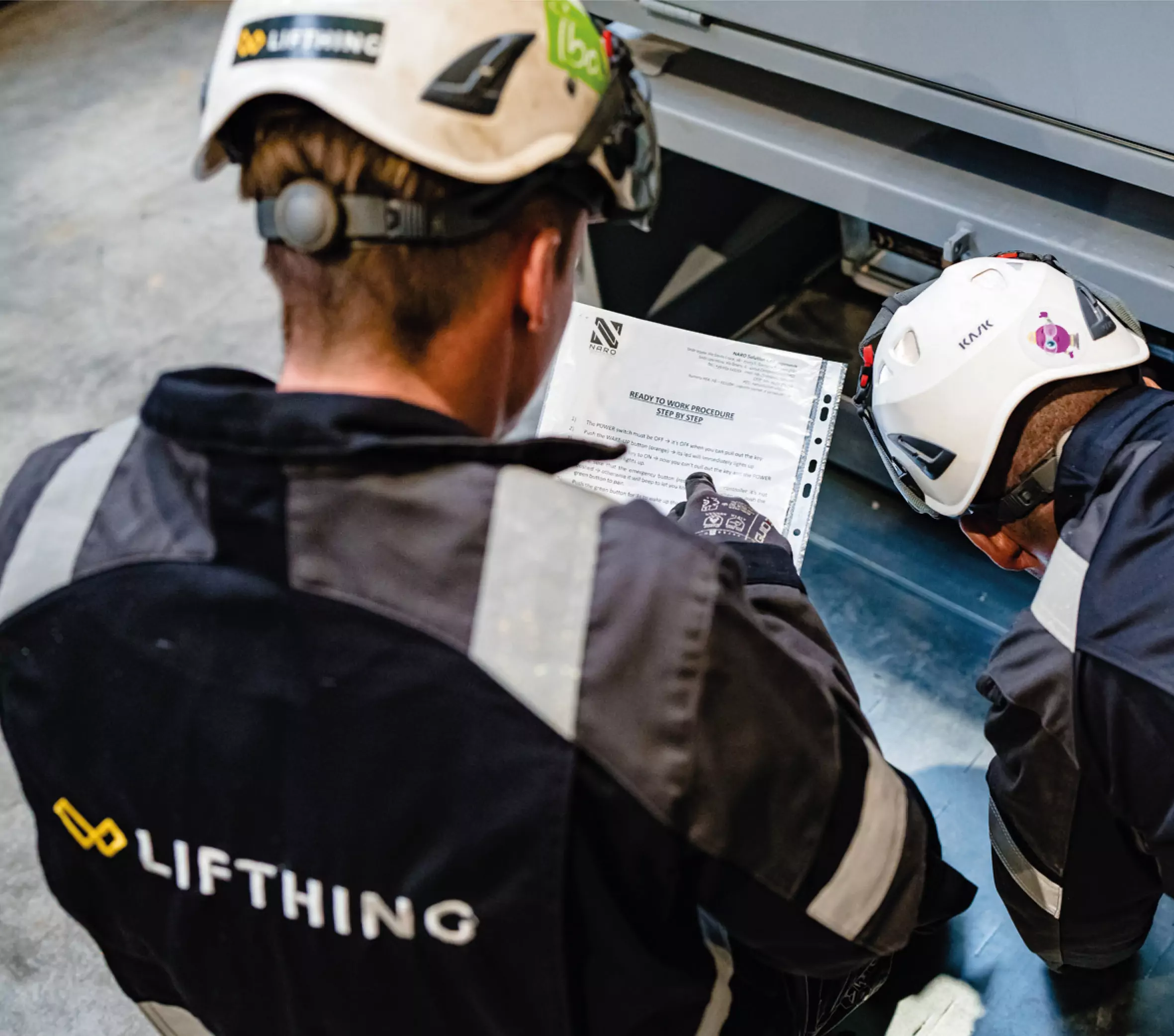
In industrial projects, complexity is often seen as the biggest risk: heavy machinery, tight spaces, strict schedules, multiple partners, zero margin for error.
But anyone who has worked in the field for years knows: projects rarely fail due to technical complexity.
They fail because of ambiguity.
Complexity is manageable
Complexity is visible. It can be analyzed, calculated, and planned for.
It requires experience, specialized people, the right equipment, and above all: time to think before you start.
At Lifthing, we don’t see complexity as a problem, but as a reality.
In fact, this is exactly where craftsmanship makes the difference.
What is complex:
- Tight tolerances during installation
- Heavy loads in existing buildings
- Production that cannot be interrupted
- Interfaces between multiple contractors
These are not surprises. This is our daily work.
Ambiguity is invisible at the start, but merciless during execution.
Ambiguity arises when:
- Responsibilities are not clearly defined
- Assumptions are made (“someone else will probably handle that”)
- Risks are not explicitly addressed
- Decisions are postponed “until on-site”
And this is exactly where problems occur in projects.
Not because something is technically impossible, but because no one knows exactly:
- Who makes the decisions
- Who is ultimately responsible
- What the fallback plan is if things don’t go as planned
Complexity demands clarity, not improvisation
In complex installations, improvisation is not flexibility — it’s a risk.
That’s why Lifthing strongly believes in:
- A single clear point of contact
- Explicitly defined scope
- Preparation that goes beyond “it’ll probably work”
- Clearly stating what is out of scope
Clarity is not an administrative burden.
It brings calm on site, builds trust with the client, and ensures safety for everyone.
Why we ask difficult questions
Clients sometimes experience us as “critical” during the preparation phase.
We ask the questions others skip. We point out risks that may feel uncomfortable.
Complexity requires partners who dare to say:
“This is possible — but only if we first make this clear.”
From ambiguity to control
When everything is clear — roles, timing, responsibilities, risks —
even the most complex project becomes manageable.
Then what is often only realized in hindsight happens:
- Less stress
- Fewer course corrections
- Better collaboration
- A result that works, both technically and humanly
Our conviction
Complexity belongs in industry.
Ambiguity does not.
At Lifthing, we consciously choose to neutralize complexity with clarity.
Not by making everything seem simpler than it is, but by leaving nothing unspoken.
Because, in the end, every industrial project follows the same truth:
What is clear can be controlled.
What remains ambiguous will surprise you.